Samsung Exynos 2600: The World's First 2nm Mobile Chip — A Complete Deep Dive
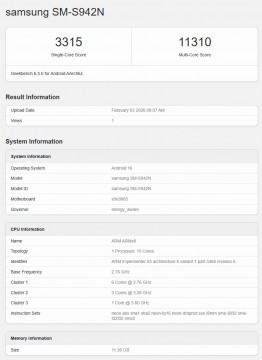 Galaxy S26 (SM-S942N) running Geekbench with Exynos 2600 — Source: GSMArena
Introduction
Samsung has long been in a chip battle with Qualcomm, and with the Exynos 2600, the company is swinging harder than ever. Announced in December 2025 and slated to power the Galaxy S26 and Galaxy S26+ in select markets, the Exynos 2600 is the world's first smartphone processor built on a 2nm Gate-All-Around (GAA) manufacturing process — a milestone that beats Apple, Qualcomm, and MediaTek to the punch.
This isn't just a spec sheet refresh. The Exynos 2600 represents a fundamental rethink of Samsung's chip architecture: a brand-new CPU core topology, a generationally-upgraded GPU with AMD's latest ray tracing tech, a dramatically more powerful NPU, and a new thermal management system designed to address the throttling issues that plagued previous Exynos chips.
Full Specifications at a Glance
| Component | Specification |
|---|---|
| Process Node | Samsung 2nm GAA (Gate-All-Around) |
| CPU Architecture | Arm v9.3, 10-core (Deca-core) |
| CPU Config | 1x C1-Ultra @ 3.8GHz + 3x C1-Pro @ 3.25GHz + 6x C1-Pro @ 2.75GHz |
| GPU | Xclipse 960 (AMD RDNA 4, ~985MHz peak) |
| NPU | 32K MAC, dedicated AI engine |
| SME Support | SME2 (multi-vector AI acceleration) |
| Memory | LPDDR5X |
| Storage | UFS 4.1 |
| Display | 4K @ 120Hz, HDR10+ |
| Camera ISP | Up to 320MP, Zero Shutter Lag @ 108MP |
| Video | 8K @ 30fps, 4K @ 120fps w/ HDR, APV codec |
| Modem | External — Shannon 5410 5G |
| Connectivity | External chip (Wi-Fi, Bluetooth) |
| Thermal Tech | Heat Path Block (HPB) — High-k EMC material |
| Security | Hardware-backed hybrid Post-Quantum Cryptography (PQC), first in mobile |
CPU: Arm's New C1 Cores Take Center Stage
The Exynos 2600 dials down the complexity of its CPU layout while turning up raw performance. Samsung has gone all-in on a 1+3+6 core configuration, discarding traditional low-power "little" cores entirely in favor of Arm's latest C1-Ultra and C1-Pro cores across the board.
- 1x Cortex-C1 Ultra — Prime core @ 3.8GHz (peak single-core performance)
- 3x Cortex-C1 Pro — Performance cores @ 3.25GHz
- 6x Cortex-C1 Pro — Efficiency-tuned cores @ 2.75GHz
Samsung claims this configuration delivers 39% more CPU performance compared to the Exynos 2500. The chip also introduces support for SME2 (Scalable Matrix Extension 2), which allows lightweight AI tasks — like text-to-speech, summarization, and inference — to run faster on the CPU without spinning up the dedicated NPU. This not only reduces latency but can meaningfully improve power efficiency for AI-heavy workloads.
How Does It Compare to Snapdragon 8 Elite Gen 5?
| Exynos 2600 | Snapdragon 8 Elite Gen 5 | |
|---|---|---|
| Prime Core | 1x C1-Ultra @ 3.8GHz | 2x Oryon Prime @ 4.6GHz |
| Perf Cores | 3x C1-Pro @ 3.25GHz | — |
| Mid Cores | 6x C1-Pro @ 2.75GHz | 6x Oryon Perf @ 3.62GHz |
| SME | SME2 | SME |
| Process | 2nm GAA (Samsung) | 3nm N3P (TSMC) |
The Snapdragon's Oryon Prime cores run nearly 800MHz faster, which shows in single-core benchmarks. However, the Exynos's 10-core layout with SME2 gives it a potential edge in multi-threaded and AI-adjacent workloads.
Benchmark Performance Numbers
AnTuTu 10
The Exynos 2600, as seen in the Galaxy S26 (SM-S942N), posted a total AnTuTu score of 2,825,908 — a staggering result that places it firmly in flagship territory.
| Sub-Score | Score |
|---|---|
| CPU | 751,772 |
| GPU | 1,058,872 |
| Memory | 504,880 |
| UX | 310,384 |
| Total | 2,825,908 |
GeekBench 6
 Exynos 2600 GPU benchmark results — Source: SammyGuru
Early GeekBench 6 results from the South Korean Galaxy S26 (SM-S942N) show competitive but not dominant single-core performance, with the multi-core score pulling ahead of Snapdragon:
| Device | Chip | Single-Core | Multi-Core |
|---|---|---|---|
| Galaxy S26 (Exynos) | Exynos 2600 | 3,315–3,455 | 11,310–11,621 |
| Galaxy S26 (Snapdragon) | SD 8 Elite Gen 5 | 3,378 | 11,097 |
| Galaxy S25 | SD 8 Elite for Galaxy | 3,175 | 10,050 |
The multi-core result is a clear win for Exynos — the extra cores pay off when all threads are loaded. Single-core, however, tells a story of Snapdragon's custom Oryon cores holding an edge.
GeekBench 6 Detailed Sub-Scores (Single-Core)
| Test | Score |
|---|---|
| Asset Compression | 459.4 MB/sec |
| HTML 5 Browser | 328.1 pages/sec |
| PDF Renderer | 345 Mpixels/sec |
| Image Detection | 259.1 images/sec |
| HDR | 344.2 Mpixels/sec |
| Background Blur | 41.7 images/sec |
| Photo Processing | 97.1 images/sec |
| Ray Tracing | 12.2 Mpixels/sec |
| Compute Score (GPU) | 22,829 |
GPU: Xclipse 960 — Samsung's AMD-Powered Ace Card
 Exynos 2600 GPU benchmarks showing top-tier ray tracing performance — Source: GSMArena
If there's one area where the Exynos 2600 definitively wins, it's GPU performance — particularly ray tracing.
The Xclipse 960 (reportedly codenamed "AMD JUNO") operates at approximately 985MHz and is built on AMD's latest RDNA 4 architecture — the same generation powering AMD's current desktop/laptop graphics cards. This is a massive generational leap over the RDNA 2-based Xclipse 920 found in the Exynos 2400.
Samsung's claims for the Xclipse 960:
- 2× compute performance vs. the Exynos 2500 GPU
- 50% better ray tracing vs. the Exynos 2500 GPU
- ENSS (Exynos Neural Super Sampling) — AI-based resolution upscaling + frame generation for up to 3× smoother gameplay
Real-World Ray Tracing Benchmark
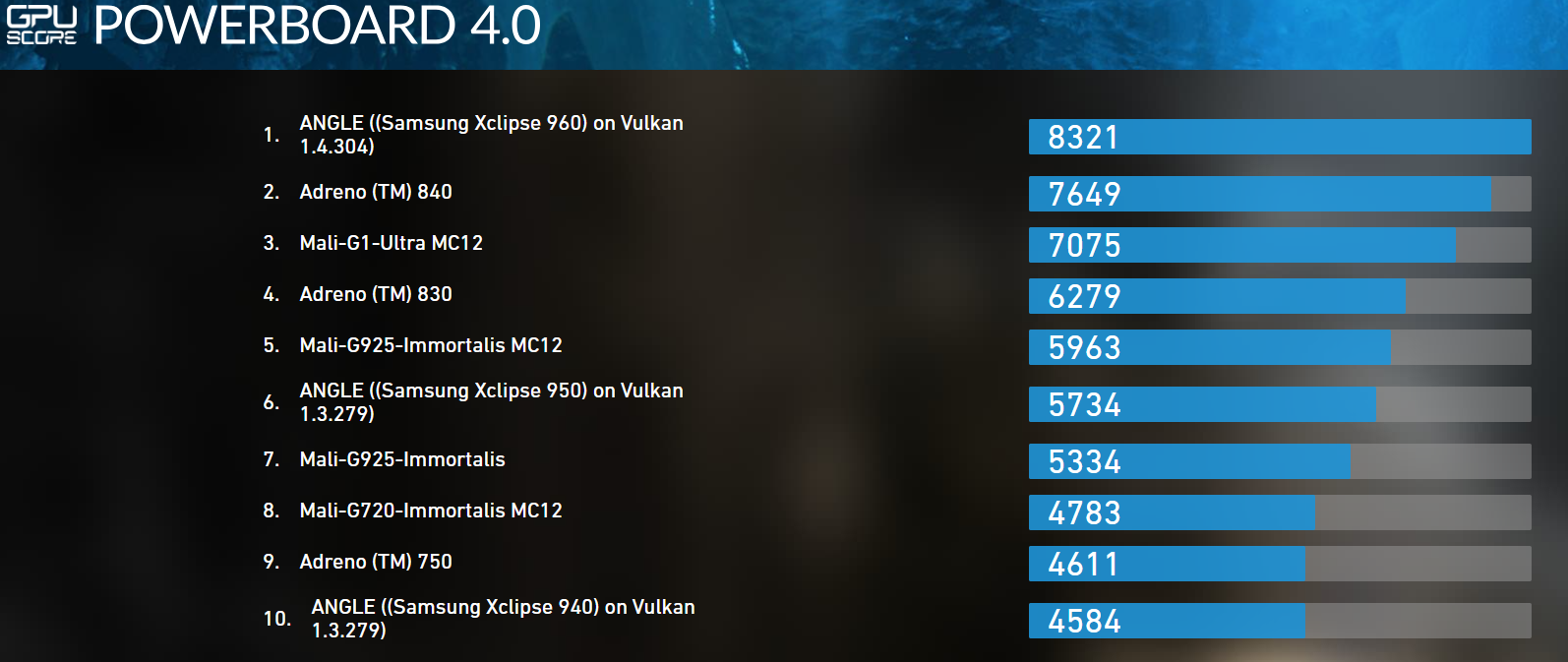
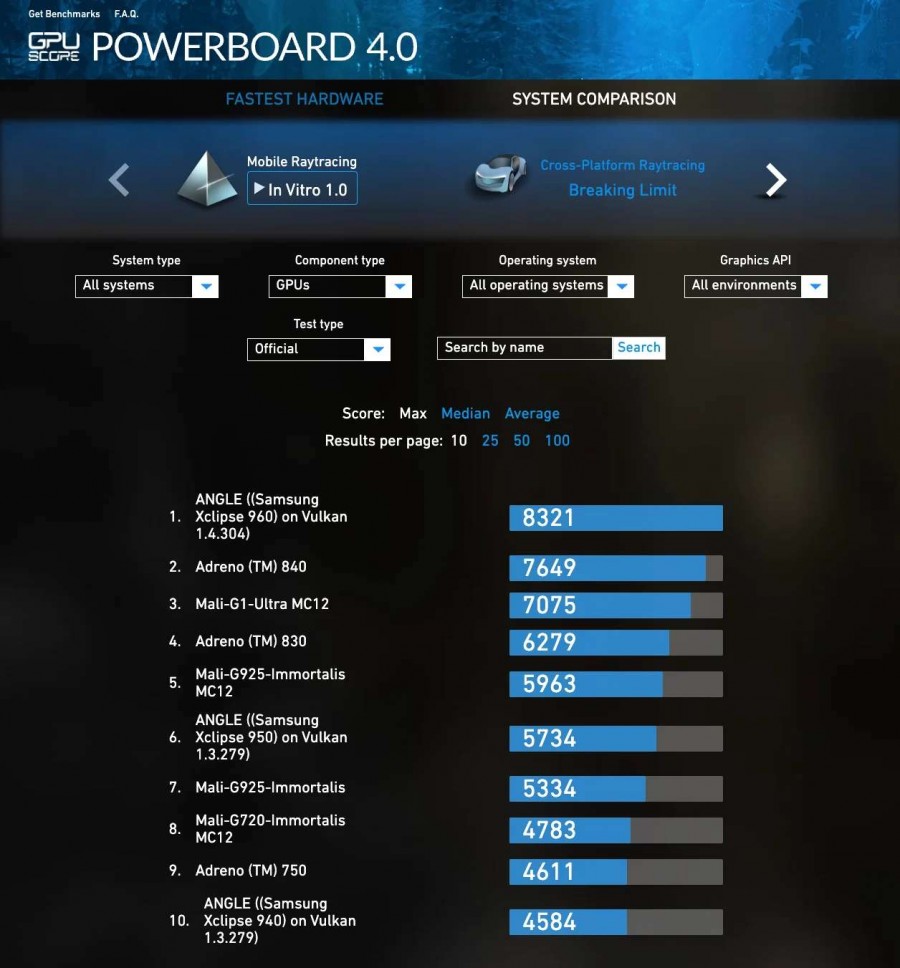
In Basemark's In Vitro 1.0 Ray Tracing test, the Xclipse 960 posted 8,321 points — topping the mobile GPU charts:
| SoC | GPU | Ray Tracing Score |
|---|---|---|
| Exynos 2600 | Xclipse 960 | 8,321 |
| Snapdragon 8 Elite Gen 5 | Adreno 840 | ~7,704 (~8% lower) |
| Dimensity 9500 | Mali-G1 Ultra | ~7,111 (~17% lower) |
The Exynos 2600 beats Qualcomm's Adreno 840 by around 8% and MediaTek's Mali-G1 Ultra by 17% in ray tracing. AMD's RDNA 4 hardware ray tracing implementation is clearly showing results.
AI & NPU: 113% Leap in Generative AI
The Exynos 2600's 32K MAC NPU is claimed to deliver 113% more AI performance than its predecessor, the Exynos 2500's NPU. This is a monumental jump, not just in peak throughput but in the kinds of on-device AI models the chip can run:
- On-device image editing and generative AI features
- Real-time AI assistant inference (lower latency, no cloud dependency)
- SME2 support for lightweight AI directly on CPU (no NPU spin-up required)
- VPS (Visual Perception System) — real-time detection of fine visual details, including eye-blink detection for portrait modes
The chip also debuts hardware-backed hybrid Post-Quantum Cryptography (PQC) — a first for any mobile SoC — ensuring that sensitive AI-processed data is protected against future quantum computing threats.
Camera & Video Capabilities
The Exynos 2600's ISP is a significant upgrade on the imaging front:
- Up to 320MP camera sensor support
- Zero Shutter Lag at 108MP
- 8K video @ 30fps, 4K @ 120fps with HDR
- APV codec support for higher quality video recording
- DVNR (Deep Learning Video Noise Reduction) for cleaner low-light video
- 50% more power-efficient ISP vs. Exynos 2500
Thermal Management: The HPB Breakthrough
Past Exynos chips — especially the Exynos 2400 in the Galaxy S24 — faced serious criticism over thermal throttling and sustained performance degradation. Samsung has directly addressed this with the Heat Path Block (HPB) technology.
HPB uses High-k EMC (Epoxy Molding Compound) material to dramatically improve how heat is channeled out of the chip. Samsung claims this reduces internal operating temperatures by approximately 30%, allowing the Exynos 2600 to sustain high performance for longer without throttling.
The External Modem Question
One of the most debated design choices in the Exynos 2600 is its reliance on an external Shannon 5410 5G modem — a departure from the integrated modem approach used in the Exynos 2400 and Exynos 2500.
Why Samsung made this call: The 2nm GAA silicon is extremely dense with CPU, GPU, NPU, and ISP components. Offloading the modem freed up die space for performance-critical blocks.
The trade-off: External modems require data to travel between chips, which theoretically introduces additional power draw — especially during streaming, downloads, and video calls. However, Apple has successfully used external modems in iPhones for years with excellent battery life results, suggesting this isn't necessarily a dealbreaker.
Exynos 2600 vs. Snapdragon 8 Elite Gen 5: Quick Verdict
| Category | Winner |
|---|---|
| Single-Core CPU | Snapdragon 8 Elite Gen 5 |
| Multi-Core CPU | Exynos 2600 |
| Ray Tracing GPU | Exynos 2600 |
| General GPU | Likely close — Snapdragon may lead rasterization |
| AI / NPU Claims | Exynos 2600 (113% uplift claimed) |
| Process Node | Exynos 2600 (2nm vs 3nm) |
| Integrated Modem | Snapdragon 8 Elite Gen 5 |
| Thermal Sustained | TBD — HPB looks promising |
Which Phones Will Get the Exynos 2600?
Based on current reports and leaked Geekbench listings:
- Galaxy S26 (global/Korea/Europe variants) — Exynos 2600
- Galaxy S26+ (global/Korea/Europe) — Exynos 2600
- Galaxy S26 Ultra (worldwide) — Snapdragon 8 Elite Gen 5
- US, China — All S26 models get Snapdragon 8 Elite Gen 5
- Galaxy Z Flip8 — Also expected to use Exynos 2600
Final Thoughts
The Exynos 2600 is Samsung's most ambitious chip to date. The leap to 2nm GAA is a genuine industry milestone, the Xclipse 960's AMD-powered ray tracing is class-leading, and the 113% NPU uplift opens the door to more capable on-device AI experiences.
The single-core CPU performance still lags behind Qualcomm's custom Oryon cores — a gap that may or may not matter depending on your use case. The external modem is a wildcard for real-world battery life. And Samsung's track record with sustained performance and thermals makes HPB's real-world impact critical to watch.
Whether Exynos finally closes the gap with Snapdragon in day-to-day performance will become clear once Galaxy S26 reviews hit. What's certain is that Samsung has built the most technically interesting Exynos chip in years — and the mobile chip landscape is better for it.